
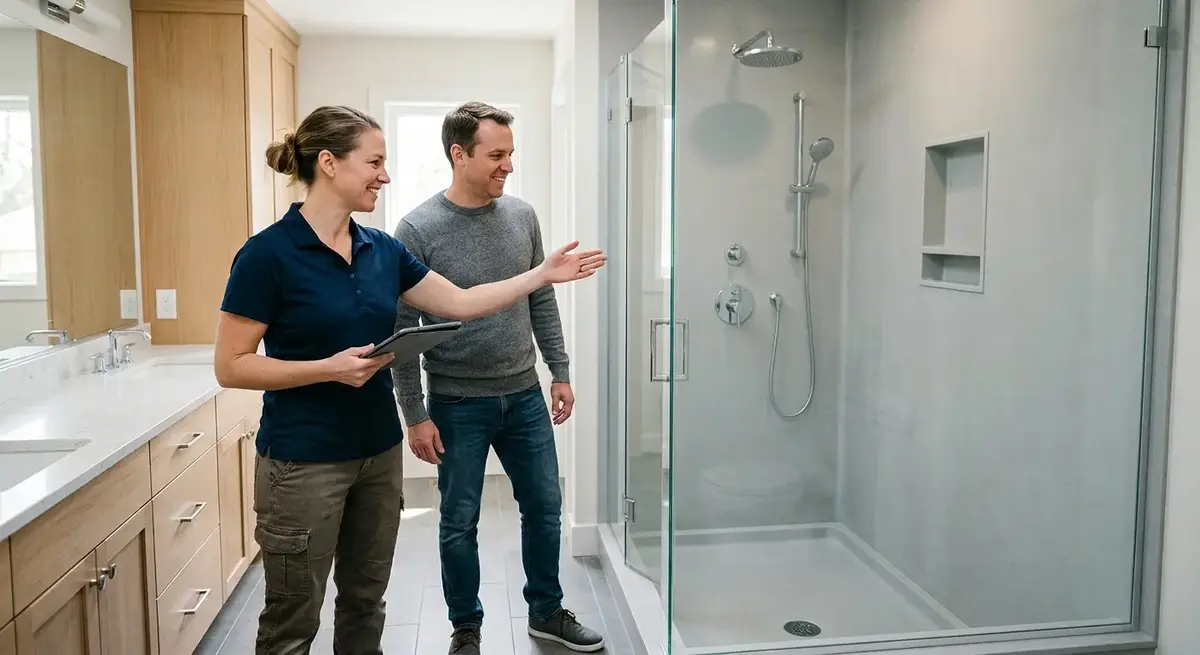
Most people who start looking into bathroom remodel financing are not trying to find out whether they can afford a new bathroom. They already know they want one. What they want to know is what it costs per month, how much interest they hand over to get there, and whether the contractor sitting in their living room is quoting a fair deal or a padded one.
This guide covers the real options, what separates them, what actually determines the rate you are offered, and how to choose the right financing option for your situation. Bathroom Brad is an owner-operated remodeling company in Las Vegas, and we currently offer $2,000 off plus 0% interest for up to 24 months with $0 down, for qualified buyers with approved credit. That option is covered below alongside the ones that have nothing to do with us, because the point is to pick the right one, not to steer you.
What Bathroom Financing Actually Costs You
Two numbers decide whether a payment plan is a good one. The monthly payment tells you whether it fits your budget. The total interest tells you what the convenience cost you. Contractors tend to advertise the first number and stay quiet about the second.
Here is the arithmetic, using round figures for illustration rather than a quote. Finance $15,000 over 24 months at 0% and you pay about $625 a month and nothing in interest. Stretch the same $15,000 over 60 months at a double-digit rate and the monthly payment drops by more than half, which feels better, but you can easily add several thousand dollars in interest before the loan term ends.
Neither is automatically wrong. A longer loan term with a smaller payment is the right call for some households. Just make the comparison on both numbers before you sign, and ask any lender for the total cost of borrowing over the full term, not only the payment.
The Five Ways to Pay for a Bathroom Remodel
Nearly every bathroom remodeling project in Las Vegas gets paid for one of five ways.
Cash. No interest, no approval process, no paperwork. If you have the savings to fund a bathroom remodel outright and no higher-return use for that money, this is the cheapest option and always will be. Many homeowners use cash for part of the job and finance the rest, which is covered further down.
Contractor financing. The remodeling company partners with a finance provider and offers flexible financing options, usually a promotional plan at 0% interest for a fixed number of months. It is arranged during the estimate, so there is no separate application to chase. The catch to watch for is what happens after the promotional window closes, so ask directly whether deferred interest applies.
A personal loan. Personal loans for bathroom remodel work are unsecured, which means your house is not on the line. Funds arrive as a lump sum, rates are fixed, and terms usually run two to seven years. Because nothing secures the debt, this route carries a higher interest rate than a home equity product for the same borrower. Banks, credit unions and online lenders all market these as home improvement loans, and a credit union is worth a call before you assume the online rate is the best available.
A home equity loan or HELOC. Both borrow against the equity in your home. A home equity loan is a lump sum at a fixed rate. A home equity line of credit works more like a credit card you draw against, usually at a variable rate. Both typically come with lower interest rates than unsecured borrowing, because the debt is secured by your home. That is also the risk, and it is not a small one: putting your home as collateral behind a bathroom means missed payments carry consequences a personal loan does not. If you do not have much equity built up yet, this option is off the table anyway.
A cash-out refinance. You replace your existing mortgage with a larger one and take the difference. This only makes sense when you were already planning to refinance and current rates beat what you hold. Trading a good mortgage rate to pay for your remodel is usually an expensive way to do it.
Contractor Financing vs a Bank Loan
Contractor financing wins on speed and simplicity. The application happens at your kitchen table, decisions are usually quick, and a genuine 0% promotional plan is difficult to beat because there is no interest to compare against. If you can clear the balance inside the promotional window, it is often the cheapest financing available to you.
A bank or credit union wins when you want a longer runway or you are financing more than one job. If the bathroom is the first of several home improvement projects, a credit line you can draw against repeatedly beats opening a new plan each time.
The honest version most home remodeling companies will not put on their website: if you cannot realistically clear a promotional plan before it expires, a plain fixed-rate loan at a modest rate is often the better deal, even though the sticker looks worse. Run both.
How to Choose the Right Financing Option
Three questions settle it for most households.
Can you clear the balance inside a promotional window? If yes, a 0% contractor plan is almost always the right financing, because zero interest cannot be beaten by a low rate.
Do you have meaningful equity and a long horizon? If the bathroom is one of several projects and you want a reusable pool of money, home equity wins on cost.
Do you want your house kept out of it entirely? Then it is an unsecured loan for a bathroom remodel, at a higher rate, with the tradeoff bought deliberately.
Most companies will pre-qualify you with a soft credit check that does not affect your score, so you can compare financing options for your bathroom before committing to a formal application. Do that first. It costs nothing and it turns a guess into a number.
What Credit Score You Need, and What Affects Your Rate
There is no single minimum credit score for a bathroom remodel loan. Different providers set different floors, and the same applicant can be approved by one and declined by another on the same day. Good credit widens the options and lengthens the promotional terms you are offered, but it is not the only input.
What consistently moves the rate you are offered:
- Your credit profile. Payment history and how much of your available credit you are using carry the most weight.
- Income and debt load. Underwriters weigh what you already owe each month against what you earn.
- Secured or unsecured. Home equity products price lower because there is collateral behind them.
- Length of the term. Shorter usually carries lower interest rates and higher payments.
- Equity, if you are borrowing against the house. More equity generally means better pricing.
Every promotional offer, ours included, is subject to credit approval. Nobody can tell you what you will qualify for without running your application, and you should be skeptical of anyone who claims otherwise before looking at your file.
How Much You Actually Need to Finance in Las Vegas
The financing question is easier to answer once you know the cost of a bathroom remodel at the scope you actually need, and scope is what drives it. Replacing a failed shower or converting an unused tub is a different budget from gutting the room. Projects with Bathroom Brad start at $12,500, and a full picture of local pricing and what drives it sits in our guide to a bathroom remodel in Las Vegas.
Scope is the biggest lever you control. A wet-area remodel replaces the shower or tub, the walls around it, and the fixtures in that zone. A full bathroom renovation adds vanities, toilets, flooring and often electrical. The wet area is where Las Vegas hard water does its damage and where most of the daily frustration lives, so a focused project frequently solves the actual problem for a fraction of a gut renovation. If you are weighing a specific conversion, the numbers behind a tub to shower conversion cost break that scope down on its own.
Can You Remodel a Bathroom for $5,000 or $10,000?
At $5,000 you are in cosmetic territory. New fixtures, paint, a vanity swap, maybe reglazing. That is real work and it can transform how a room looks, but it does not replace a failing shower pan or rotten substrate, and it will not stop hard water from destroying grout again.
At $10,000 you are close to a straightforward wet-area replacement in this market, depending on size and material choices. Below the cost of doing it properly, the honest answer is usually to wait, save, or finance the difference rather than to buy a version of the job that fails in three years. A remodeling company that tells you every budget works is selling, not advising.
Mixing Cash With Financing
This is the move most homeowners overlook. Put down whatever cash you are comfortable parting with, then finance the remainder. Two things improve at once: the financed balance shrinks, and a promotional 0% window becomes far easier to clear before it expires.
A simple example. On a $16,000 project, financing the whole amount over 24 months means roughly $667 a month. Put $4,000 down and the same 24 months runs about $500. The cash you contributed did double duty, lowering the payment and making the interest-free window realistic instead of aspirational.
Bathroom Brad Financing: $2,000 Off and 0% for Up to 24 Months
Our current offer is $2,000 off your project plus 0% interest for up to 24 months, with $0 down and low monthly payments, for qualified buyers with approved credit.
What that means in practice: you are not draining savings to start, and if you clear the balance inside the term you pay nothing for the privilege of spreading it out. The discount comes off the project price first, so it reduces the amount being financed rather than sitting on top of it.
We are owner-operated and we do not use subcontractors, which matters here for an unglamorous reason. There is no layer of markup between the crew doing the work and the price you are financing.
How Fast the Approval Process Moves
Contractor plans are built for speed. The application is handled during the in-home estimate and a decision usually comes back the same visit, which is why so many bathroom remodeling projects are financed this way rather than through a bank.
Unsecured loans from online providers often fund within a few business days. Home equity loans and credit lines take the longest, commonly a few weeks, because an appraisal and title work are required. If a failed shower is actively leaking, that timing difference matters more than a point of interest.
Is a Bathroom Remodel a Good Investment?
Bathroom remodeling reliably returns a meaningful share of its cost at resale, and among household projects it consistently sits near the top for return. But resale is the smaller half of the answer for most of the homeowners we work with.
The larger half is that you use the room every day, and a walk-in shower that is safe and takes ten seconds to wipe down changes daily life in a way a new roof does not. A dream bathroom is worth financing when you are standing in it every morning for the next fifteen years. For older homeowners, an accessible bathroom is often what makes staying in the house possible at all. Our guide to walk-in bathtub installation in Las Vegas covers that side of it.
Frequently Asked Questions
What are the financing options for a bathroom remodel?
Cash, contractor financing through the company doing the work, an unsecured personal loan, a home equity loan or line of credit, and a cash-out refinance. Most Las Vegas households pick one of the first three for projects in the $10,000 to $25,000 range, and home equity for larger jobs.
What credit score is needed for a bathroom remodel loan?
There is no universal minimum. Each provider sets its own threshold and weighs income and existing debt alongside the score. Good credit generally means better pricing and longer promotional terms. Every offer, including ours, is subject to credit approval.
How long can you finance a bathroom remodel?
Promotional contractor plans commonly run 12 to 24 months. Unsecured loans typically run two to seven years. Home equity products can extend much further. Longer is not better by default, since more months usually means more total interest even when the payment looks friendlier.
Do I need home equity to get a bathroom remodel loan?
No. Unsecured options and contractor financing do not require equity at all. Equity only matters if you choose a home equity loan or a HELOC.
How quickly can I get approved for bathroom remodel financing?
Contractor decisions usually come back during the estimate appointment. Unsecured loans often fund in a few business days. A HELOC generally takes a few weeks.
Can I finance just a shower or a walk-in tub instead of the whole bathroom?
Yes. Financing applies to the project, whatever its scope. A single wet-area replacement is a smaller amount to finance than a full renovation, which is part of why focused projects are easier to approve and faster to pay off.
Does financing cover labor or only materials?
The full project price, materials and labor together. You are financing the job, not a shopping list.
Getting a Real Number
Financing math only works once you know the actual project price, and that requires someone standing in your bathroom. Our in-home estimate is free, carries no obligation, and ends with a firm number rather than a range. From there, turning it into an affordable bathroom remodel is a short conversation, not a sales process.