
Most people who go looking for low maintenance shower walls are not chasing a finish. They are trying to stop losing a Saturday to a grout brush. The good news is that the upkeep problem in a shower is almost entirely solvable, and the solution has very little to do with how hard you scrub.
The maintenance in a shower does not live on the surface. It lives in the joints. Get the joints right and the wall becomes something you wipe down instead of something you attack.
What Low-Maintenance Shower Walls Actually Means
A genuinely low-maintenance shower wall does four things. It is non-porous, so water and soap scum sit on top instead of soaking in. It has few or no seams, because every seam is a place mold and mildew can start. It tolerates ordinary cleaners without dulling. And it never needs resealing.
Tile fails the first three of those tests, not because it is a bad shower material, but because it is a system of small pieces held together by mortar joints, and those joints are the weak point.
The Real Problem Is the Grout, Not the Surface
Cement grout is porous by design. It absorbs water, and with water it absorbs everything dissolved in it. In a hard water area those minerals deposit inside the grout lines, expand, and gradually work the joint loose at the edges.
Then the cleaning makes it worse. The products homeowners reach for to fight scale are acidic, and acid dissolves the binder faster than it dissolves the deposit. Eventually water gets behind the wall and into the substrate, where nobody sees it until the surface sounds hollow.
That is the cycle a low-maintenance shower wall is built to break. For the local water chemistry behind it, see our guide to a bathroom remodel in Las Vegas.
Low-Maintenance Shower Wall Materials, Compared
Acrylic Shower Wall Panels
Acrylic is the most common low-maintenance material in modern shower remodeling. It is completely non-porous, it comes in large format sheets so a typical shower needs only two or three panels, and it cleans with a soft cloth and a non-abrasive cleaner.
An acrylic shower will not stain, will not host mildew inside the surface, and never needs sealing. The trade-off is that acrylic can be scratched by abrasive pads, and a deep scratch cannot be buffed out. Treat it gently and it will outlast the fixtures around it.
Solid Surface Panels
Solid surface is the same family of material as Corian, and it is the premium end of the grout-free range. The color runs through the panel rather than sitting on the face, so a scuff can be sanded out rather than lived with.
These panels carry more texture and pattern options than acrylic, including finishes that convincingly mimic tile and natural stone with no joints. Onyx is one of the better known product lines here. It costs more and is heavier to install, but its durability is the highest of any seamless option.
Cultured Marble
Cultured marble is crushed stone bound in resin under a gel coat. It is seamless, waterproof and easy to clean while that coat is intact. The caveat is that the coat is the only protective layer, and once it dulls the panel underneath is porous. A reasonable middle option with a shorter window than the two above.
Porcelain Tile
Porcelain is a genuinely excellent material, dense and nearly non-porous, and it will outlast almost anything else in the bathroom. Large format porcelain reduces the number of joints considerably, which narrows the upkeep gap.
But tile and grout still means resealing and a brush. If you love that look, choose it knowing you are accepting more work in exchange. That is a fair trade when it is deliberate.
Natural Stone
A natural stone shower is the highest upkeep option here. Marble, travertine and slate are porous, they need periodic resealing, and many are etched by exactly the acidic cleaners people use on soap scum. Stone is beautiful. It is not low-upkeep, and no sealer makes it so.
Fiberglass
Fiberglass is inexpensive and seamless, which sounds ideal. In practice the gel coat is soft, it yellows with age, and it chalks. It wipes clean for the first several years and then gets progressively harder to keep looking clean. A budget material rather than a long-term one.
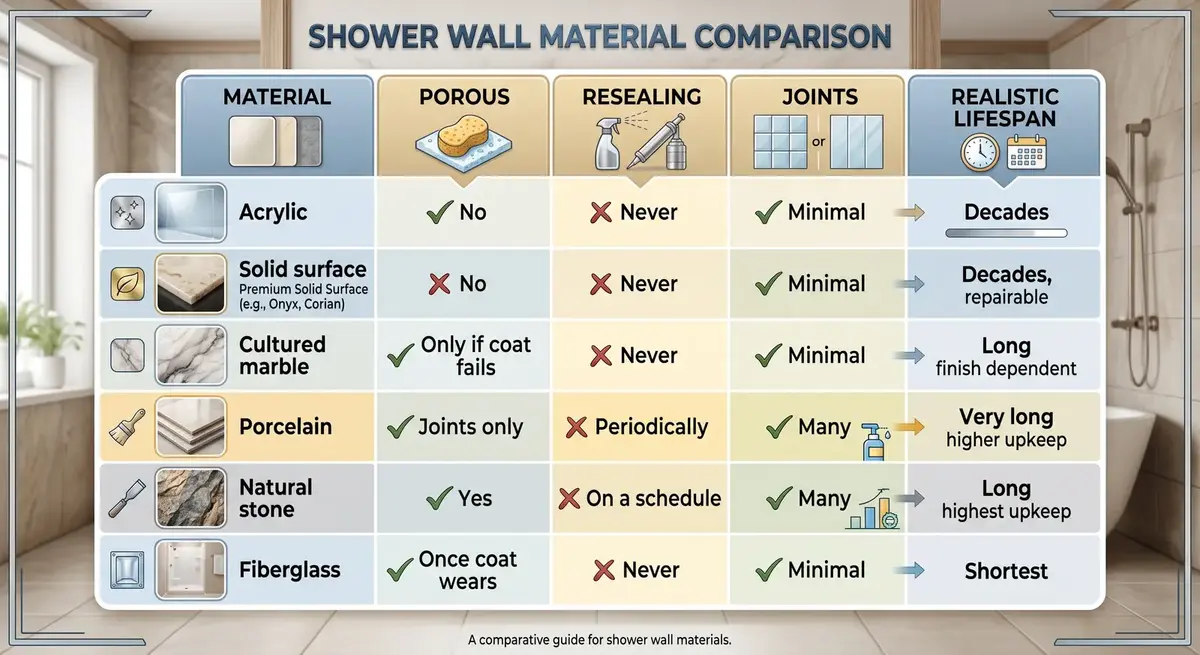
Shower Wall Material Comparison
| Material | Porous | Resealing | Joints | Realistic lifespan |
|---|---|---|---|---|
| Acrylic | No | Never | Minimal | Decades |
| Solid surface | No | Never | Minimal | Decades, repairable |
| Cultured marble | Only if the coat fails | Never | Minimal | Long, finish dependent |
| Porcelain | Joints only | Periodically | Many | Very long, higher upkeep |
| Natural stone | Yes | On a schedule | Many | Long, highest upkeep |
| Fiberglass | Once the coat wears | Never | Minimal | Shortest |
What Low-Maintenance Shower Walls Cost
Wall material is only part of a shower remodel price, and rarely the part that moves the number most. Labor, the condition of the substrate behind the old surface, and whether any plumbing moves matter more.
As a rough ordering: fiberglass at the bottom, acrylic in the value range, cultured marble slightly above, tile in a wide band that depends entirely on the product and the labor to set it, and solid surface at the top of the seamless options.
Our complete wet area remodels start at $12,500, which covers the full job rather than the walls alone. For where the money actually goes on a job like this, see our breakdown of tub to shower conversion cost.
What Ruins a Low-Maintenance Shower Wall
Three habits undo the benefit of a good material.
Abrasive pads. A scouring pad puts fine scratches into acrylic and gel coat. Those scratches hold soap scum, so the wall gets harder to clean, so people scrub harder. Use a soft cloth or a non-scratch sponge.
Acidic descalers. Sold for hard water, and they do remove scale, but they dull a gel coat finish and eat the joints in any tiled shower. A mild cleaner used often beats an aggressive one used occasionally.
Letting water sit. No surface resists mineral deposits if water dries on it. Thirty seconds with a squeegee after the last shower of the day does more for a shower enclosure than any product.
A Cleaning Routine That Actually Works
For a non-porous wall panel the whole routine is short. Squeegee or towel the walls after use. Wipe down weekly with a mild cleaner and a soft cloth. That is the entire upkeep requirement: no resealing, no brush, no annual project.
Can You Install Shower Wall Panels Over Existing Tile?
Sometimes, and it is worth asking, because it removes a demolition day from the project. Panels can go over sound, flat, well-bonded surfaces in some situations.
What rules it out is moisture damage behind the wall. If water has been getting past failed joints for years, covering the problem traps it. Any honest installer will check the substrate before quoting an overlay and will tell you to open it up if there is doubt. A shower that looks fine can be holding a real repair behind it.
How to Choose the Right Shower Wall Material
Work through it in this order.
Start with how much upkeep you will genuinely do. Not the routine you intend to adopt, the one you will actually keep. If the honest answer is a wipe down and nothing more, that rules out grouted surfaces and natural stone.
Then consider the water. In a hard water area the case for a jointless wall is much stronger, because the failure is not cosmetic, it is structural.
Then look at the finish you want. Solid surface offers the widest range of textures and the best tile-look options. Acrylic covers most tastes at lower cost.
Finally, weigh how long you plan to stay. A new shower built with a non-porous panel system and professional installation should be the last one that bathroom needs. If you are converting a tub at the same time, our guide to a tub to shower conversion in Las Vegas covers the process end to end.
Frequently Asked Questions
What is the best low-maintenance shower wall material?
Solid surface and acrylic are the two strongest options. Both are non-porous, both are effectively seamless, and neither needs sealing. Solid surface costs more and is repairable; acrylic is the better value.
Are shower wall panels better than tile?
For upkeep, clearly. For appearance it depends on taste, though modern wall panels that mimic tile have narrowed that gap. Choose it only if you want that look specifically and accept the work.
Do low-maintenance shower walls last as long as tile?
A quality acrylic or solid surface wall will last decades. Tile can last longer, but the grout between it will not, and joint failure is what ends most tiled showers.
How do I stop mold and mildew in a shower?
Remove the porous surfaces it grows in, and ventilate. Mildew needs moisture and something to hold onto. A seamless, non-porous wall gives it neither.
Can I get a tile look without grout lines?
Yes. Several acrylic and solid surface lines press a stone or tile pattern into a continuous panel, so you get the visual break with nothing to maintain.
Does a walk-in shower with low-maintenance walls add home value?
An updated walk-in shower is one of the more reliable bathroom improvements for resale, and a high-quality wall system shows better than an aging surround and discolored joints.
Getting a Low-Maintenance Shower Built Right
Material choice matters, but installation decides whether a shower stays low-maintenance. Panels cut tight, sealed correctly at the pan and corners, and set against a sound substrate are the difference between a wall you wipe and a wall that quietly fails behind the finish.
We install seamless wet area systems and back the work with a lifetime workmanship warranty alongside the manufacturer warranty on the products themselves. To talk through which material fits your bathroom, see our shower remodel services or request a free estimate.