
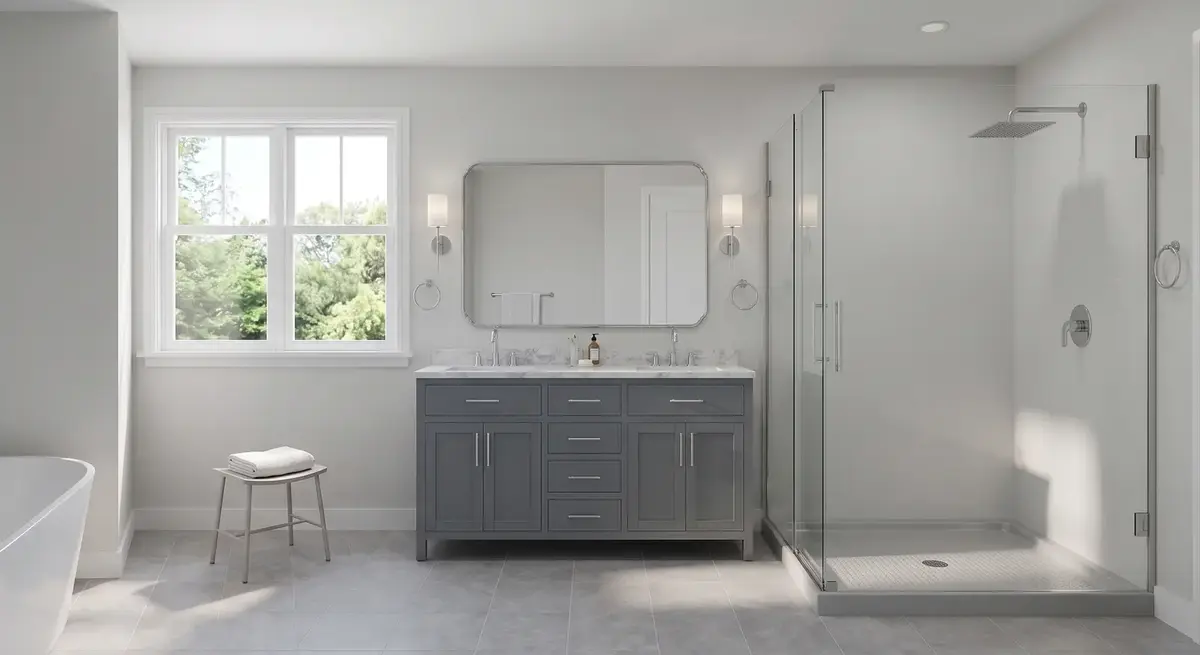
People searching for a quick tub to shower conversion almost always have a date in mind. A parent is coming home from rehab in two weeks. A tenant moves in on the first. Someone is having surgery next month and the bathroom has to be usable when they get back. Or the house lists in thirty days and the avocado tub has to go.
The deadline changes the answer, so start there. If yours is measured in weeks, a full conversion fits comfortably. If it is measured in days, you are looking at a different product entirely — and you should know which one you are being sold.
Option 1: The Tub Cut Kit
A tub cut, sold as a bathtub conversion kit or step-in kit, removes a section of your existing bathtub wall and caps the opening with a molded insert. The bathtub stays. You get a low step-in threshold instead of a 15-inch wall.
Time: three to six hours, single visit.
Cost: roughly $1,500 to $3,500 with professional installation.
Best for: a hard deadline inside a week, a rental, or a senior who needs safer access immediately.
The honest limitations: you still have a bathtub, just with a doorway in it. The floor of the bath is still the floor you stand on, same width, same surface. It solves the step-over. It does not give you a walk-in shower and it does not modernize the bathroom.
Option 2: The Full Tub to Walk-In Shower Conversion
The bathtub comes out completely and a new shower goes in — base, waterproofing, wall system, valve, fixtures.
Time: one to two days on site for a straightforward job.
Cost: starting around $12,500.
Best for: anyone with two or more weeks of runway who wants the space and the finished result rather than a modified fixture.
The Part Nobody Tells You: Lead Time vs. Install Time
This is where most "how fast" answers mislead. The installation is one to two days. Getting to the installation is usually two to four weeks, because the shower base, panels, and valve have to be ordered and arrive before demolition starts.
So when someone advertises a one-day bath remodel, they are describing the day the crew is in your house, not the calendar from your phone call to your finished shower. If your deadline is three weeks out, you are fine. If it is Friday, no full conversion in the country can help you, and anyone who says otherwise is going to install over whatever is behind that wall.
What Makes the Work Fast — or Slow
A conversion from a tub stays quick when:
- The footprint does not change. A standard 60-inch alcove becomes a standard shower with no framing work.
- The drain stays put. Moving it means opening the floor, which adds a day minimum.
- The wall system is panel-based. Acrylic or solid surface goes up in hours. Tile is a multi-day build with cure time between steps.
- Nothing is rotten. Framing and subfloor repair is the most common reason a two-day job becomes a four-day job.
- Materials are on site before demolition. The fastest installer alive cannot install a shower base that has not arrived.
How Homeowners Actually Get the Fast Timeline
- Tell your installer the actual deadline and why. A move-in date and a hospital discharge get scheduled differently. We hold room for the second kind.
- Make selections before demo day. Base, walls, valve, fixtures, glass. Every open decision is a day added.
- Accept the existing footprint unless you have a strong reason not to.
- Choose a base that takes the existing drain or an offset.
- Clear the bathroom and the path to it. Crews lose real hours moving your belongings.
- Agree in writing what happens if there is water damage. An allowance keeps a discovery from becoming a three-day pause while a change order gets approved.
The Tub-to-Shower Conversion Process, Hour by Hour
Day one: demolition
- Morning: protection down, fixtures pulled, the old bath cut apart and carried out. Removing a bath is the loud part and it is over quickly.
- Midday: inspection of framing, subfloor, and the plumbing wall. This is the moment that decides whether your schedule holds.
- Afternoon: repairs, blocking for grab bars, new valve set, shower base dry-fit and levelled.
Day two: installing the new shower
- Morning: waterproofing, then wall panels or surround.
- Afternoon: trim, showerhead, glass or door, sealant, walkthrough.
Convert your tub with tile instead of panels and day two becomes days two through five, because tile needs setting, grouting, and cure time. That single material choice is the biggest schedule variable in the whole bathroom remodel.
Be Careful With One-Day Bathtub to Shower Claims
The national brands built their marketing on the single-day bath remodel, and mechanically it is achievable with prefabricated systems installed over existing surfaces. The trade-off is what gets skipped: looking at what is behind the wall. Installing over damaged framing gets you a fast, attractive shower and a much larger problem in three years.
Speed should be a result of a simple scope, not a promise made before anyone has seen your bathroom. A good installer will tell you honestly which one yours is.
Insert Systems: The Middle Ground
Between a tub cut and a full remodel sits a family of accessibility products: the tub insert, the bathtub insert, and the walk-thru insert that fits over your old tub. A cut out conversion kit and a walk-thru insert aim at the same goal — safer access without removing the tub — and both are marketed as an alternative to traditional demolition, done in as little as one day.
They are a great solution in specific cases. For a renter, for someone with limited mobility who needs safety and accessibility this week, or for a cast iron tub that would be brutal to remove, an insert is a sensible call. Some are reversible, which matters if you do not own the home.
What an insert cannot do is transform your bathroom. You still stand in a traditional bathtub. If the goal is a step-in shower or an accessible walk-in space that is genuinely easier to use, converting a bathtub into a walk-in shower properly is the version that delivers it.
Matching the option to the deadline
- Days, and safety is urgent: a tub to shower conversion kit or tub insert, minimize spend, revisit later
- Weeks, and you want to keep soaking: a walk-in tub
- Weeks, and you are staying in the home: convert your bathtub fully
Bathtub to Shower Conversion: Planning Checklist
Settle these before the crew arrives. Every open item is time added:
- Shower base size and drain position
- Wall finish, panels or tile
- Glass panel or a door
- Valve and showerhead selection, including a handheld
- Grab bar and bench placement
- A written allowance for hidden repair
A bathtub to shower conversion run from a settled plan is a predictable two days. The same job with decisions made on site is a week, and neither the installer nor the homeowner enjoys it.
Kit vs Full Conversion: Quick Comparison
| Tub cut conversion | Full conversion | |
|---|---|---|
| Install time | Half a day | 1–2 days |
| Lead time | Days | 2–4 weeks |
| Cost | $1,500–$3,500 | From $12,500 |
| Result | Existing bathtub with a step-in opening | New walk-in shower |
| Solves slip and fall risk | Partly | Yes |
| Modernizes the bathroom | No | Yes |
| Aging in place | Short-term fix | Long-term solution |
What a Walk-In Shower Adds That a Kit Cannot
A tub conversion kit changes how you get in. A walk-in shower changes the room. Converting your tub to a walk-in shower gives you a wider standing area, a seamless wall system with no bathtub floor to step down into, and space to add an accessible shower seat and grab bars properly.
For anyone planning to stay in the house, that difference matters. Aging in place works better when the bathroom is designed for it rather than patched toward it. A tub to walk-in shower conversion is a bathroom remodel confined to the wet area — a renovation you do once, not a fixture you modify twice.
Tub Cut or Walk-In Shower: Which Should You Choose?
If the deadline is real and money is tight, a tub cut is a reasonable bridge and nobody should make you feel bad about it. If you are going to spend on the bathroom anyway, a full conversion costs more once instead of twice — most people who do the cut first convert properly within a few years.
For what the full version costs, see tub to shower conversion cost. For the reasoning behind converting at all, why replace your tub with a walk-in shower. If accessibility is driving the deadline, handicap shower conversion in Las Vegas, and if you would rather keep the soak, walk-in bathtub installation. Local scheduling is covered on our tub to shower conversion in Las Vegas page.
Common Questions
Can a tub to shower conversion really be done in one day?
The install, sometimes — when the footprint and drain stay put, the walls are panel-based, and nothing needs repair. Two days is the realistic promise, and materials still have to arrive first.
What is the fastest option if I only have a week?
A tub cut or an insert. Say so on the first call; we will tell you honestly whether a full conversion can make your date rather than finding out on demo day.
Is a tub cut out kit a DIY project?
Some are sold that way. Cutting a bathtub accurately and sealing the insert so it does not leak is harder than the marketing suggests, and a leak inside a wall is expensive. Professional installation is worth it here.
Does a fast conversion mean lower quality?
Not inherently. Speed from a simple scope is fine. Speed from skipping inspection and waterproofing is not. Ask specifically what happens behind the wall.
What if you find water damage mid-project?
The timeline changes, and it should. Anyone who promises a fixed finish date before seeing behind the bathtub is guessing.
Will I lose the bathroom the whole time?
The wet area, yes. The rest is usually usable. Households with a second bath barely notice a one-to-two-day project.